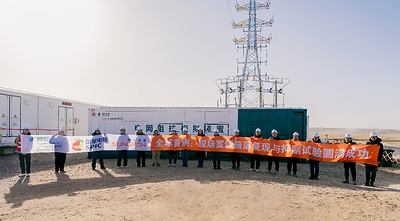
HEFEI, China, Sept. 17, 2026 /PRNewswire/ -- Sungrow, a globally leading PV inverter and energy storage system provider, recently has achieved a world first by controllably reproducing and successfully suppressing wideband oscillation at a real-world 500 MW solar-plus-storage plant in Qinghai, China. The field test marks a major step toward addressing one of the long-standing challenges facing renewable power systems as renewable penetration continues to increase worldwide.
As renewable penetration rises worldwide, wideband oscillation has become a major challenge, with severe cases potentially causing renewable plants to disconnect from the grid or shut down. In 2014, the BorWin1 offshore HVDC project in Germany experienced oscillations at 250–350 Hz, which damaged filter capacitors on the offshore converter platform and led to a shutdown lasting approximately six months, causing substantial economic losses to the local utility. In 2019, the Hornsea offshore wind farm in the UK experienced widespread disconnection due to subsynchronous oscillation, resulting in a loss of approximately 3.2% of the system load and affecting around one million users. Past incidents have demonstrated the significant impact of oscillation-related events.
However, the complex and unpredictable nature of the phenomenon has made it difficult to safely and controllably reproduce oscillations at real-world plants and validate effective suppression methods in the field. As a result, research has largely remained at the theoretical and simulation stage, with limited systematic validation in actual power plant environments.
To bridge this gap, Sungrow and its industry partners conducted a field test at the plant, using Sungrow PV inverters deployed across the site.
Controlled Reproduction of Wideband Oscillation
The test established weak-grid conditions and identified three key contributing factors—power output, system short-circuit ratio (SCR), and control parameters—before successfully achieving controlled reproduction of a localized system oscillation.
Rapid Suppression of Wideband Oscillation
The field test evaluated the oscillation suppression performance of Sungrow's PV inverters under different grid conditions. Leveraging Sungrow's patented grid-strength adaptation technology, the inverters identified grid strength within 40 milliseconds, adjusted their control strategies accordingly, and rapidly stabilized voltage and frequency.
The test also validated the effectiveness of grid-forming control in suppressing wideband oscillation. Sungrow's grid-forming control strategy enables stable operation across a wide SCR range of 1~40 and effectively mitigates transient overvoltage.
By successfully reproducing and suppressing wideband oscillation at a real-world 500MW plant, the field test marks a critical step in moving wideband oscillation suppression from the laboratory into engineering practice, with the potential to improve the stability of renewable energy plants under extremely weak grid conditions, prevent grid disconnections caused by oscillations, unlock greater power export capacity for plants connected to weak grids, and reduce generation losses.
"For renewable energy to become a truly stable and reliable source of power, it is essential to develop autonomous fault self-healing and grid-support capabilities." Pan Nian'an, Chief Engineer and Chief Expert for Utility PV BU at Sungrow, said Sungrow will continue to advance research and development in grid technologies, focusing on key innovations including wideband oscillation suppression, grid-forming control, and multi-energy coordination. These efforts aim to support the stable grid integration and efficient utilization of renewable energy while strengthening the technical foundation for a secure and stable energy transition and next-generation power systems.

 View original content to download multimedia:https://www.prnewswire.co.uk/news-releases/sungrow-achieves-world-first-wideband-oscillation-reproduction-and-suppression-at-500-mw-plant-302881815.html

Die Berliner Linken-Politikerin Elif Eralp geht juristisch gegen Bundesinnenminister Alexander Dobrindt (CSU) vor. Eralp und ihr Berliner Landesverband haben nach Angaben ihres Rechtsbeistands Strafanzeige beziehungsweise Strafantrag gegen den Minister gestellt. Hintergrund ist eine Passage in der ZDF-Talkshow „Maybrit Illner“, in der sich die Moderatorin versprochen und Eralp in einem Satz fälschlich als Antisemitin bezeichnet hatte, bevor sie sich sofort korrigierte. Dobrindt kommentierte diese Szene mit den Worten „Na doch“.
Aus Sicht des von Eralp mandatierten Anwalts Jasper Prigge macht sich der Minister damit den Versprecher der Moderatorin zu eigen. In einem Schriftsatz, der mehreren Medien vorliegt, heißt es, Dobrindt stelle durch seine Einlassung eine Tatsachenbehauptung auf, die den Tatbestand der üblen Nachrede erfülle. Zudem liege eine Beleidigung vor, weil die Bezeichnung als Antisemitin „in erheblichem Maße ehrabträglich“ sei. Eralp habe sich nach Darstellung ihres Anwalts selbst nie in einer Weise geäußert, die als antisemitisch zu bezeichnen wäre, vielmehr trete sie öffentlich für den Schutz jüdischen Lebens ein.
Der Anwalt spricht von einer „Falschbehauptung des Innenministers“. Die Äußerung im Fernsehen sei geeignet, das öffentliche Wirken der Berliner Spitzenpolitikerin erheblich zu erschweren. In dem Schriftsatz wird darauf verwiesen, dass die Verbreitung des Eindrucks, Eralp würde selbst sagen, sie sei Antisemitin, ihre Integrität als politische Amtsträgerin infrage stellen und damit auch Auswirkungen auf politische Prozesse in Berlin haben könne. Eralp ist Spitzenkandidatin der Linken für das Rote Rathaus.
Die Auseinandersetzung hatte sich in der ZDF-Sendung an einem Schlagabtausch zwischen Dobrindt und der Linken-Bundestagsfraktionschefin Heidi Reichinnek entzündet. Während der Debatte unterlief Moderatorin Maybrit Illner der Versprecher, sie korrigierte sich jedoch unmittelbar mit dem Hinweis, Eralp sei „keine Antisemitin“. Dobrindts anschließender Kommentar bildet nun den Kern des juristischen Streits. Zu möglichen weiteren Schritten der Strafverfolgungsbehörden und einer Reaktion des Bundesinnenministers lagen zunächst keine näheren Angaben vor.