EDINA, Minn., Sept. 15, 2026 /PRNewswire/ -- ReEmerge, Inc. (ReEmerge), a private MedTech company innovating a new way to address cognitive impairment, launched from stealth today following the close of an oversubscribed $37M Series A financing. The proceeds will support an upcoming clinical study that will evaluate ReEmerge's proprietary Cognitive Network Restoration Therapy (CNRT) in its first clinical indication, traumatic brain injury (TBI), while advancing technology development, expanding clinical and regulatory operations, and preparing the platform for future indications. U.S. Venture Partners (USVP) and Santé co-led the round, with significant participation from Oxford Science Enterprises, 415 Capital, IAG Capital Partners, The Vertical Group, and Dendrion Ventures.
"ReEmerge's technology represents a fundamentally different approach to cognitive recovery with the potential to transform the recovery pathway," commented Jonathan Root, MD, General Partner at USVP. "The size of the opportunity and the profound unmet need make this an especially compelling market for innovation. We are excited about this technology and the new hope it aims to offer patients and their families."
"TBI does not discriminate. It can happen to anyone at any age, and its consequences can fundamentally alter a person's ability to live, work, and engage with the world around them," said Auriel August, MD, Principal at Santé. "CNRT could offer people living with TBI something they have too often been told not to expect, namely the possibility of meaningful cognitive recovery."
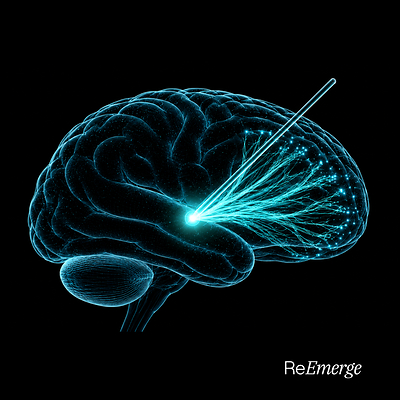
CNRT is a proprietary, first-of-its-kind approach that precisely targets neural networks in the central thalamus, a brain hub involved in attention, arousal, and executive function. Rather than bypassing damaged pathways or asking patients to compensate for lost function, CNRT aims to augment the recovery journey by driving underactive but viable neural circuits. By restoring function across existing but underperforming networks, CNRT aims to reverse cognitive deficits and allow recovery to extend further.
This technology grew out of decades of research by Nicholas Schiff, M.D. Professor of Neuroscience in the Feil Family Brain and Mind Research Institute at Weill Cornell Medicine and colleagues at Stanford University and the University of Utah, which explored the possible restorative effect of brain electrical stimulation after TBI. A pilot study showed promising results, with patients regaining cognitive function. The Center for Technology Licensing at Weill Cornell worked closely with Dr. Schiff's team to protect the intellectual property, provide internal translational gap funding, and license the foundational intellectual property to ReEmerge to advance clinical and commercial development of CNRT.
Building upon this groundbreaking clinical research, including a publication in Nature Medicine, ReEmerge will conduct a prospective, single-arm, multicenter study (NCT07730099) to evaluate this treatment, enrolling up to 40 patients with chronic moderate-to-severe TBI. Additionally, the study will explore potential effects on cognitive and functional outcomes.
"As a physician-scientist and co-founder, it has been very rewarding to see the arc of benchtop science moving forward and being translated into a meaningful clinical development pathway," stated Dr. Schiff. "I am excited for us to advance the testing of treatment for many patients, who have historically had limited therapeutic options, as we look to shift cognitive care from rehabilitation to restoration and ultimately, to redefine recovery."
Each year, an estimated 27 million people worldwide experience a traumatic brain injury, and many are left with persistent cognitive impairment.1 Current recovery pathways focus on rehabilitation, helping patients compensate for cognitive deficits through structured routines, adaptive strategies, and supportive therapies. While these interventions can improve function, the journey can be long, and recovery will often plateau, frequently leaving patients with lasting impairments that limit independence, quality of life, and personhood.
"The strong support of our stellar investor syndicate validates our mission to evolve the recovery trajectory for patients living with impaired cognitive function," said Todd Langevin, Chief Executive Officer of ReEmerge. "We look forward to initiating our clinical study in TBI and building a robust body of evidence to support our differentiated approach to treating cognitive impairment."
About ReEmerge, Inc.
ReEmerge is innovating a new way to approach chronic cognitive impairment. Developed under an exclusive licensing agreement with Cornell University, the company's novel Cognitive Network Restoration Therapy (CNRT) precisely targets neural networks disrupted by brain injury that drive underactive but viable neural circuits. By restoring function across these existing but underperforming networks, CNRT aims to reverse cognitive deficits and restore agency and personhood. To learn more about how the company is developing therapeutic innovations that evolve cognitive care from rehabilitation to restoration, please visit ReEmergeInc.com.
Media Contact
Charlene Herndon
SPRIG Consulting
charlene@sprigconsuting.com
1Guan B, Anderson DB, Chen L, et al. Global, regional and national burden of traumatic brain injury and spinal cord injury, 1990–2019: a systematic analysis for the Global Burden of Disease Study 2019
BMJ Open 2023;13:e075049. doi: 10.1136/bmjopen-2023-075049
 View original content to download multimedia:https://www.prnewswire.co.uk/news-releases/reemerge-inc-exits-stealth-with-oversubscribed-37m-series-a-to-challenge-the-limitations-of-chronic-cognitive-impairment-caused-by-brain-injuries-302878979.html

Bundespräsident Frank-Walter Steinmeier hat den Festakt zum Tag der Deutschen Einheit in Bremen für eine eindringliche Warnung vor der Gefährdung der Demokratie genutzt. In seiner voraussichtlich letzten großen Rede zu diesem Anlass sprach er von einer angefochtenen demokratischen Ordnung und mahnte, radikale Kräfte entschieden abzuwehren. Angesichts wachsender Erfolge populistischer und extremistischer Parteien sieht Steinmeier nicht nur Freiheit und Demokratie, sondern auch die innere Einheit des Landes unter Druck.
Steinmeier verwies darauf, dass inzwischen „ein Viertel und mehr“ der Wähler mit ihrer Entscheidung deutlich machten, dass sie sich von wichtigen Grundentscheidungen der Bundesrepublik abwenden. Diese Entwicklung werde begleitet von „unerträglicher politischer Demagogie“, in der Menschen verhöhnt und bedroht würden. Die Diskreditierung demokratischer Verfahren, die Radikalisierung der Öffentlichkeit und die Diffamierung des Kompromisses seien Warnsignale, die man nicht ignorieren dürfe. Populistische Parteien aller Couleur destabilisierten die parlamentarische Demokratie, sagte er.
Deutliche Kritik übte der Bundespräsident an der Rolle der sozialen Medien. Eine „Flut der Manipulationen und der Lügen“ trage zur „schrillen Emotionalisierung“ des politischen Diskurses bei und befeuere extremistische Tendenzen. Steinmeier forderte, die demokratische Streitkultur zu verteidigen und den Kompromiss wieder als Stärke zu begreifen. Ob die Demokratie in Deutschland einer Entwicklung ähnlich der Weimarer Republik entgegengehe, sei nicht entschieden – man habe es „in der Hand“.
Zugleich erinnerte Steinmeier an die historischen Grundlagen des Feiertags. Vor 36 Jahren sei mit der deutschen Wiedervereinigung eine „tiefe Wunde“ geheilt worden, die das Land zuvor über Jahrzehnte in einem „unnatürlichen Zustand der inneren Spaltung“ gehalten habe. Der Tag der Deutschen Einheit sei Anlass, die erste friedliche Revolution für Freiheit und Demokratie in Deutschland und ihre Protagonisten im Gedächtnis zu behalten. Die Errungenschaften der Einheit dürften von aktuellen Krisen nicht überdeckt werden, mahnte Steinmeier, und rief die Bürger dazu auf, sich aktiv für die liberale Demokratie einzusetzen. Er zeigte sich überzeugt, dass diese den aktuellen Belastungen standhalten könne: „Wir sind so viel stärker, als wir glauben.“




