Medium-term plan emphasizes "Trusted Growth", "GEMBA DX", and portfolio restructuring, positioning Europe as one of the focus regions in OMRON's global transformation strategy.
KYOTO, Japan, March 11, 2026 /PRNewswire/ -- OMRON Corporation (TSE: 6645), recently announced its medium-term roadmap, Shaping the Future 2030 (SF2030) 2nd Stage, outlining a strategic path to return to sustainable growth led by devices and transform into a data-driven "GEMBA DX (on-site digital transformation) company." Covering the period through 2030, the plan combines offensive investments in 13 focus businesses with defensive structural reforms to rebuild the company's portfolio and strengthen execution capability.
"Trusted Growth reflects our strong desire to deepen the relationship of trust with our customers and once again achieve strong growth in order to transform ourselves into GEMBA DX company," said Junta Tsujinaga, President & CEO, OMRON Corporation. "GEMBA DX fuses and multiplies high-quality data obtained from devices, which is one of OMRON's strengths, with other data from the field, utilizing knowledge to convert this data into something of value. We aim to use this data to provide data services that solve our clients' essential problems."
Key Strategic Pillars of SF2030 2nd Stage
Europe as a Focus Region
As per Fernando Colás, CEO, OMRON Industrial Automation Europe, "UK manufacturers are under increasing pressure to improve productivity while managing skilled labour shortages and operational complexity. By combining our automation technologies with strong local expertise, we help customers move from fragmented automation toward more autonomous and efficient operations, in a practical, scalable way."
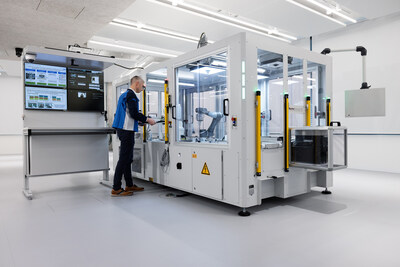
OMRON is reinforcing its support for UK manufacturers through local expertise and education services. By combining application engineering, training programs, and on-site support, OMRON helps customers strengthen internal capabilities and adopt automation technologies that address skills gaps, while implementing scalable automation solutions more effectively.
The company also aims to recover and expand its share among machine builders in strategic markets such as Italy and Spain by offering various devices and tailored automation solutions.
Photo - https://mma.prnewswire.com/media/2930241/OMRON_DE_and_UK_Image.jpg
Logo - https://mma.prnewswire.com/media/2803499/5855560/OMRON_Logo.jpg
 View original content:https://www.prnewswire.co.uk/news-releases/omron-charts-data-driven-path-to-2030-for-european-business-302710488.html


Zalando hat 2025 kräftig zugelegt und seine eigenen Ziele am oberen Ende der Spannen erreicht. Der Umsatz des im DAX notierten Online-Modehändlers stieg um 16,8 Prozent auf 12,35 Milliarden Euro und lag damit leicht über den Markterwartungen. Das Bruttowarenvolumen (GMV) kletterte um 14,7 Prozent auf 17,56 Milliarden Euro. Rückenwind bekam das Geschäft vor allem durch die Übernahme des Konkurrenten About You sowie den verstärkten Einsatz Künstlicher Intelligenz in Vertrieb und Plattformsteuerung.
Operativ verbesserte sich Zalando ebenfalls: Das bereinigte Ergebnis vor Zinsen und Steuern (EBIT) erhöhte sich auf 591 Millionen Euro nach 511 Millionen Euro im Vorjahr, die Marge blieb mit 4,8 Prozent stabil und leicht über den Analystenprognosen. Unter dem Strich sank der Gewinn jedoch auf 213 Millionen Euro von zuvor 251 Millionen Euro und verfehlte damit die Erwartungen. Für das laufende Jahr stellt das Management ein weiteres Wachstum von 12 bis 17 Prozent bei GMV und Umsatz in Aussicht; das bereinigte EBIT soll auf 660 bis 740 Millionen Euro steigen. Die mittelfristigen Ziele bis 2028 – jährliche Zuwächse von 8 bis 13 Prozent bei Umsatz und GMV sowie eine EBIT-Marge von 6 bis 8 Prozent – wurden bestätigt, die angepeilten jährlichen Synergien aus der About-You-Übernahme von 100 Millionen Euro sollen bereits 2028 und damit ein Jahr früher erreicht sein.
An der Börse sorgte vor allem die Kapitalmarktpolitik für Auftrieb. Der Konzern kündigte ein Aktienrückkaufprogramm von bis zu 300 Millionen Euro an, das bis Ende Juli laufen soll. Die Aktie legte im Tagesverlauf zweistellig zu und notierte zeitweise rund elf Prozent höher bei 22,35 Euro. Damit reagierte der Markt positiv auf die Kombination aus besser als erwarteten operativen Kennzahlen, bestätigtem Wachstumskurs und der Ankündigung, überschüssiges Kapital an die Anteilseigner zurückzuführen – obwohl die Zalando-Papiere seit Jahresbeginn deutlich im Minus liegen und in den vergangenen zwölf Monaten rund ein Drittel an Wert verloren haben. Analysten hoben neben dem Rückkauf insbesondere die Rolle von KI und das Konzept des sogenannten Agentic Commerce als nächste Entwicklungsstufe des Onlinehandels hervor.
Überschattet werden die guten Zahlen von strukturellen Einschnitten im Logistiknetz. Im Zuge der Integration von About You will Zalando vier Logistikzentren in Europa schließen, darunter den Standort Erfurt mit rund 2.700 Beschäftigten. Co-Chef David Schröter sprach von einer der schwersten, zugleich aber notwendigen Entscheidungen, um die Kapazitäten an den künftigen Wachstumsbedarf anzupassen. Das Unternehmen verhandelt nach eigenen Angaben mit dem Betriebsrat über einen Sozialplan, bietet Versetzungen an andere Standorte an und arbeitet mit der örtlichen Arbeitsagentur zusammen. Weitere Maßnahmen über die bereits angekündigten Schließungen hinaus soll es dem Management zufolge nicht geben; aus der Thüringer Landespolitik kommt dennoch Kritik an der Entscheidung.


,regionOfInterest=(955,281)&hash=27c131b7533e2d4916860cc04ae4112762ad11c6c6490fc505e779e190a65bcd)