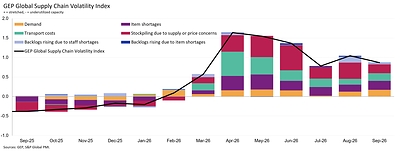
CLARK, N.J., Oct. 12, 2026 /PRNewswire/ -- GEP Global Supply Chain Volatility Index — a leading indicator tracking demand conditions, shortages, transportation costs, inventories and backlogs, based on a monthly survey of 27,000 businesses — showed global manufacturers ramping up purchases of raw materials and components in September as underlying demand strengthened.
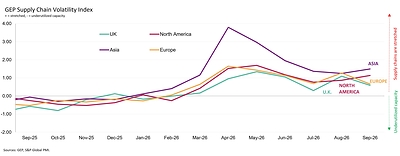
Global input demand growth rose to its strongest since May and was close to its 2026 high, signaling firmer manufacturing activity heading into the fourth quarter. Purchasing strengthened across North America, Asia and Europe, with particularly strong increases in the United States, Germany, Taiwan and South Korea.
At the same time, supply pressures intensified. Shortages increased for the first time since May, while global transportation costs also rose. Shortages of oil and oil-based products were particularly acute, creating renewed cost and availability pressures for manufacturers.
"Manufacturers are buying more because demand is strengthening, but they're doing so at a time when shortages and transportation costs are starting to rise again," said John Piatek, vice president, GEP Consulting. "For companies, that means the priority shifts from simply protecting inventory to securing supply and controlling costs. If demand continues to build through the fourth quarter, businesses that wait will face tighter availability and higher input costs."
Interpreting the data:
Index > 0, supply chain capacity is being stretched. The further above 0, the more stretched supply chains are.
Index < 0, supply chain capacity is being underutilized. The further below 0, the more underutilized supply chains are.
SEPTEMBER 2026 REGIONAL KEY FINDINGS
SEPTEMBER 2026 KEY FINDINGS
For more information, visit www.gep.com/volatility.
Note: Full historical data dating back to January 2005 is available for subscription. Please contact economics@spglobal.com.
The next release of the GEP Global Supply Chain Volatility Index will be 8 a.m. ET, Nov. 11, 2026.
About the GEP Global Supply Chain Volatility Index
The GEP Global Supply Chain Volatility Index is produced by S&P Global and GEP. It is derived from S&P Global's PMI® surveys, sent to companies in over 40 countries, totaling around 27,000 companies. The headline figure is a weighted sum of six sub-indices derived from PMI data, PMI Comments Trackers and PMI Commodity Price & Supply Indicators compiled by S&P Global.
A Supply Chain Volatility Index is also published at a regional level for Europe, Asia, North America and the U.K. For more information about the methodology, click here.
Media Contacts
Derek Creevey
Director, Public Relations
GEP
Phone: +1 646-276-4579
Email: derek.creevey@gep.com
Joe Hayes
Senior Principal Economist
S&P Global Market Intelligence
Phone: +44-1344-328-099
Email: joe.hayes@spglobal.com
 View original content to download multimedia:https://www.prnewswire.co.uk/news-releases/manufacturers-ramp-up-purchasing-in-september-as-global-demand-strengthens-gep-global-supply-chain-volatility-index-302905220.html

Der hessische Ministerpräsident Boris Rhein (CDU) hat eine Neujustierung des Umgangs mit der AfD im Bundestag gefordert und damit eine innerparteiliche wie parlamentarische Grundsatzdebatte angestoßen. In einem Interview mit dem Magazin „Stern“ plädierte der CDU-Politiker dafür, der AfD die ihr nach dem üblichen Verteilungsschlüssel zustehenden Vorsitzendenposten in den Fachausschüssen des Bundestags nicht länger zu verwehren. „Die Partei ist gewählt, und so sollte man mit ihr auch umgehen“, sagte Rhein und verwies darauf, dass die AfD im hessischen Landtag und in anderen Länderparlamenten bereits Ausschussvorsitze innehat.
Im Bundestag verfügt die AfD wie die anderen Fraktionen über ein Vorschlagsrecht für bestimmte Ausschussvorsitze. Bisher scheiterte sie jedoch regelmäßig daran, dass ihre Kandidatinnen und Kandidaten bei den Wahlen in den Ausschüssen nicht die Unterstützung der Abgeordneten der übrigen Parteien erhielten und damit die nötigen Mehrheiten verfehlten. Eine Klage der AfD-Bundestagsfraktion vor dem Bundesverfassungsgericht blieb im September 2024 ohne Erfolg; Karlsruhe sah keinen Anlass, in das Verfahren der Ausschussbesetzungen einzugreifen. Politisch aber gewinnt die Frage durch Rheins Vorstoß neue Brisanz.
Rhein grenzt sich zugleich von einer inhaltlichen Annäherung an die AfD ab und lehnt ein Verbotsverfahren gegen die Partei ab. Er halte das vielzitierte Bild einer „Brandmauer“ für falsch, betonte der CDU-Landeschef. Für die Union gelte: „Wir grenzen uns klar von der AfD ab, aber wir grenzen die Partei nicht aus.“ Das müsse sich auch in der Parlamentsarbeit widerspiegeln. Anstelle juristischer Schritte warb Rhein dafür, die AfD politisch zu stellen: Die CDU müsse den Wählerinnen und Wählern „ein besseres Angebot machen“ und die „Deutungshoheit über die Alltagsfragen“ zurückgewinnen. Eine Zusammenarbeit mit der AfD setze aus seiner Sicht eine „Politik der klaren roten Linien“ voraus.
Die AfD bewertet die Äußerungen des hessischen Regierungschefs als Signal eines sich abzeichnenden Kurswechsels in der Union. Der Parlamentarische Geschäftsführer der AfD-Bundestagsfraktion, Bernd Baumann, sprach gegenüber der Nachrichtenagentur AFP von einem „überfälligen“ Schritt und einem Zeichen für ein „generelles Umdenken in der CDU“. Die Forderung nach Ausschussvorsitzen sei „nur der erste Schritt – weitere werden folgen“, prognostizierte Baumann. Angesichts jüngster Wahlergebnisse sehe er die Union unter Druck, ihre bisherige Ausgrenzungsstrategie zu überdenken. Koalitionsfraktionen im Bundestag wiesen einen von Rhein geforderten Kurswechsel allerdings zurück und halten bislang an der Linie fest, AfD-Kandidaten für Ausschussvorsitze nicht zu unterstützen.
In den Fachausschüssen des Bundestags wird ein Großteil der inhaltlichen Gesetzgebungsarbeit vorbereitet. Die Vorsitzenden spielen eine zentrale Rolle bei der Organisation der Beratungen und der Tagesordnungsgestaltung. Die Verteilung dieser Schlüsselpositionen erfolgt nach einem festgelegten Schlüssel zwischen den Fraktionen, doch bleibt die tatsächliche Besetzung an die Wahl durch die Ausschussmitglieder gebunden. Vor diesem Hintergrund berührt die von Rhein angestoßene Debatte nicht nur die Machtbalance zwischen den Fraktionen, sondern auch die Frage, wie das Parlament mit Parteien umgeht, die zwar demokratisch gewählt sind, von großen Teilen des Hauses aber weiterhin klar abgelehnt werden.




