- Indonesia emerges as KT&G's largest overseas production base, with annual cigarette production capacity set to reach up to 35 billion sticks, strengthening its Asia-Pacific hub
- KT&G enters the final stage of its KRW 2.4 trillion overseas CAPEX program, backed by strengthened financial stability and continued commitment to enhancing shareholder and corporate value
SEOUL, South Korea, Oct. 7, 2026 /PRNewswire/ -- KT&G (CEO Bang Kyung-man) has begun full-scale operations at its new plant in Indonesia, completing a five-country global production system spanning South Korea, Indonesia, Russia, Kazakhstan, and Türkiye.
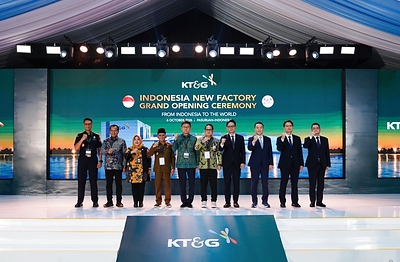
To mark the start of full-scale production, KT&G held an opening ceremony at the new plant in Pasuruan, East Java, on October 6 (local time). The event was attended by CEO Bang Kyung-man, KT&G executives and employees, Adhy Karyono, Regional Secretary of East Java Province, Yoon Soon-goo, Ambassador of the Republic of Korea to Indonesia, and other distinguished guests.
Indonesia is one of the world's major tobacco markets and an important export hub for the Asia-Pacific region. KT&G first entered the Indonesian market in 2011 through the acquisition of a local company. Since then, the company has launched ESSE, its globally leading super-slim cigarette brand, and JUARA, a brand developed specifically for Indonesia, and now ranks fourth in Indonesia's cigarette market by market share.
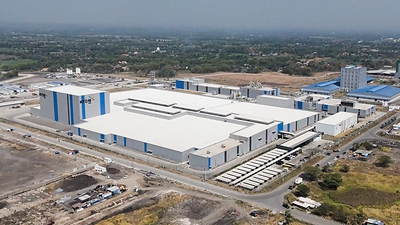
To meet growing demand in Indonesia and overseas markets, KT&G has built a new plant alongside its existing facility. Following an agreement with Indonesia's Ministry of Investment/Investment Coordinating Board (BKPM) in September 2023, the company broke ground on the new plant in April 2024 and began trial operations in the first half of 2026.
The new plant has now entered stable production. Once all nine cigarette manufacturing lines are installed, it will have an annual production capacity of up to 21 billion sticks. Combined with the existing plant's annual capacity of 14 billion sticks, KT&G's total cigarette production capacity in Indonesia is expected to reach up to 35 billion sticks, making Indonesia the company's largest overseas production base.
Leveraging Indonesia's strategic location between the Pacific and Indian Oceans, cigarettes produced at the new plant will be supplied not only to the Indonesian domestic market but also to overseas markets including Taiwan, Mongolia, Nigeria, and India. The new facility is expected to serve as a key export hub, supporting KT&G's expansion across the Asia-Pacific region and other global markets.
The construction of KT&G's new overseas plants is part of the growth investment program the company launched in January 2023. Following the completion of its new plant in Kazakhstan in April 2025 and the start of full-scale operations at the new Indonesia plant, KT&G has completed a significant portion of its previously announced KRW 2.4 trillion overseas capital expenditure program, unveiled in November 2024. Backed by strengthened financial stability, the company will continue to enhance shareholder value through share buybacks and cancellations, as well as increased dividend payouts.
Looking ahead, KT&G's four overseas production bases in Indonesia, Russia, Kazakhstan, and Türkiye are expected to have a combined annual production capacity of up to 65 billion sticks. By leveraging economies of scale and improving logistics efficiency, the company plans to increase the share of overseas production to more than 60% of its total production by 2028.
Bang Kyung-man, CEO of KT&G, said, "With the new plant in Indonesia as the final piece, KT&G has completed its large-scale overseas investment program and established a five-country global production system that will serve as a solid foundation for our global business and future growth. By strategically leveraging our production bases in Korea and overseas, we will maximize profitability, strengthen the competitiveness of our global business, and continue to increase shareholder and corporate value."
KT&G continues to expand its direct presence in global markets. The company currently operates six overseas subsidiaries in countries including Indonesia, Taiwan, Kazakhstan, and Uzbekistan, and six overseas branch offices in regions including Europe, Mongolia, and China.

 View original content to download multimedia:https://www.prnewswire.co.uk/news-releases/ktg-begins-full-scale-operations-at-new-indonesia-plant-completing-five-country-global-production-system-302900993.html

Die Exzellenzstrategie von Bund und Ländern stellt die Weichen für die nächste Förderperiode – und verschiebt die Gewichte im deutschen Wissenschaftssystem. Zu den bundesweit fünf neuen Exzellenzstandorten gehören die Technische Universität Darmstadt, die Goethe-Universität Frankfurt und die Johannes Gutenberg-Universität Mainz, die sich als Allianz der Rhein-Main-Universitäten (RMU) durchgesetzt haben. Ebenfalls erfolgreich waren in Nordrhein-Westfalen die Universität zu Köln sowie der Verbund Ruhr Innovation Lab aus TU Dortmund und Ruhr-Universität Bochum.
Für Hessen ist die Entscheidung ein Durchbruch: Erstmals tragen Universitäten des Landes ab 2027 den Titel „Exzellenzuniversität“. Die RMU-Allianz erhält nach Angaben des hessischen Wissenschaftsministeriums über sieben Jahre eine Förderung von insgesamt bis zu 155 Millionen Euro, finanziert zu 75 Prozent vom Bund. Wissenschaftsminister Timon Gremmels spricht von den ersten Exzellenzunis in Hessen und zugleich vom ersten länderübergreifenden Verbund in der Exzellenzstrategie. Ministerpräsident Boris Rhein bezeichnet den Titel als Meilenstein für die Forschungslandschaft des Landes. Ein mittelhessischer Verbund aus den Universitäten Gießen und Marburg blieb im Wettbewerb dagegen ohne Erfolg.
Auch Nordrhein-Westfalen stärkt seine Rolle als Hochburg der Spitzenforschung. Neben der Universität Köln, die den begehrten Status nach einer früheren Förderphase von 2012 bis 2019 zurückerhält, steigt der Verbund aus TU Dortmund und Ruhr-Uni Bochum als Ruhr Innovation Lab in den Kreis der Exzellenzuniversitäten auf. Nach Angaben des Düsseldorfer Wissenschaftsministeriums baut das Land damit seine Führungsposition aus. Die Universität Bonn und die RWTH Aachen hatten ihren Exzellenzstatus bereits im Frühjahr verteidigt, sodass NRW künftig mit vier Standorten vertreten ist. Ministerpräsident Hendrik Wüst wertet dies insbesondere als Signal für die internationale Sichtbarkeit des Ruhrgebiets als Wissenschafts- und Innovationsstandort.
In Bonn gaben Bundesforschungsministerin Dorothee Bär und der niedersächsische Wissenschaftsminister Falko Mohrs als Vize-Vorsitzender der Gemeinsamen Wissenschaftskonferenz (GWK) neben den Standorten in Hessen und NRW auch die Universitäten Freiburg und Jena als neue Exzellenzunis bekannt. Für Einzeluniversitäten sieht das Programm Fördermittel von bis zu 15 Millionen Euro pro Jahr vor, bei Verbünden wie der Rhein-Main-Allianz oder dem Ruhr Innovation Lab können es bis zu 28 Millionen Euro sein. Damit wächst die Riege der Exzellenzuniversitäten, deren bisher neun Standorte – darunter Aachen, Bonn, Dresden, Hamburg, Heidelberg, Karlsruhe, München, Tübingen sowie die Berlin University Alliance – ihre Förderung bereits im Frühjahr um weitere sieben Jahre verlängert hatten. Der Titel ist jeweils an regelmäßige Überprüfungen der Fördervoraussetzungen geknüpft.




