AMSTERDAM, Sept. 23, 2026 /PRNewswire/ -- Sungrow, a globally leading PV inverter and energy storage system provider, has brought its all-in-one residential energy storage system to its first European markets. PowerHarbor, which made its debut at Intersolar Europe 2026, is now available in the Netherlands, Belgium, and Luxembourg.
As net metering in the Netherlands is set to end on January 1, 2027, households with rooftop solar have reason to rethink how they use the electricity they generate. For homeowners considering storage, the key questions are practical: how will it work with their existing solar system, how much space will it need, and how easily can it be managed?
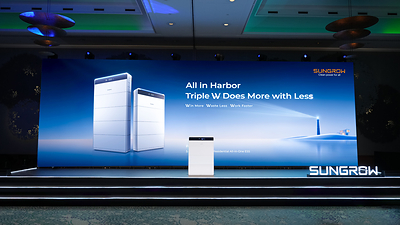
PowerHarbor is designed with these questions in mind. Under the theme "All in Harbor", it brings the inverter, battery, backup and energy management together in one system. Built around the "Triple W" value proposition—Win More, Waste Less, Work Faster—it is designed to help households get more value from their solar energy while taking up less space, requiring fewer additional devices, and enabling faster installation.
Win More with High-Power, AI-Driven Energy Flow
Capturing the midday peak. Around midday, solar generation can peak while household demand remains low, and electricity prices can fall sharply—even below zero. Surplus generation may then be exported when its market value is low. On oversized PV arrays, output can also be clipped once generation exceeds the inverter's conversion capacity.
PowerHarbor is built to keep more of that energy within the home. Its up to 160% PV-to-battery charging capability allows the battery to absorb more solar generation during peak production periods, while its 0.66P discharge rate can release the full stored capacity in around 1.5 hours when household demand or energy value rises. Together with its VPP-optimized design, these capabilities enable PowerHarbor to respond flexibly to VPP dispatch needs while sustaining performance. PowerHarbor is already integrated with 28 VPP platforms across Europe, giving households more choice in VPP programs.
Choosing the right hours. On a dynamic contract, value comes down to timing: when to charge, when to hold and when to use energy. Few households can make these decisions hour by hour, and a fixed schedule set at commissioning cannot keep pace with a constantly changing market.
PowerHarbor comes standard with iHomeManager Mini, the industry's first Mini AI solution. Activated with a single tap, its AI Mode combines weather forecasts, household consumption patterns and electricity prices to help determine when energy should be stored, held or discharged. With Shelly integration, the approach can extend to connected appliances across the home.
Powering heavy loads on any phase. In a modern home, a heat pump, induction hob and EV charger can all run at once. On a three-phase connection, those loads rarely fall evenly. High demand on one phase can reach that phase's output limit, even when output headroom remains available on the other phases. PowerHarbor supports up to 150% three-phase unbalanced output,* giving households greater flexibility to run high-power appliances when needed while making better use of their own solar energy.
Waste Less with Flexible, Compact Design
With a large installed base of rooftop solar, retrofit is an important part of the Benelux residential market. For these homes, adding storage with PowerHarbor does not have to mean starting from scratch.
Where a home already has a working PV system, PowerHarbor can be deployed as separate inverter and battery units, adding storage without replacing existing equipment. Where an existing inverter is being swapped for the all-in-one system, startup voltage is a common consideration: a higher threshold may rule out shorter strings, which can mean adding panels or rewiring. PowerHarbor's 100 V startup voltage and wide MPPT range support more string layouts, so existing strings can often be retained, subject to voltage and current compatibility.
Built with high-energy-density 314 Ah cells, the unit is just 25.5 cm deep, so it fits narrow hallways and passageways. With 6, 9 and 10 kWh battery modules and 83 possible combinations within a single unit, the system's capacity can be configured flexibly. Because each module has its own built-in battery optimizer, new modules can later be added alongside existing ones, including modules of a different capacity, without replacing batteries that still hold value.
Work Faster with Plug-and-Play Installation
PowerHarbor's battery modules stack without external cables, with the blind-mate connection taking around 10 seconds per module. All external terminals sit on the right-hand side, matching how most installers work. PowerHarbor also pairs with EnergyBridge, the industry's first Mini backup solution, which integrates five functions into a single DIN-rail-mounted device. Up to 99% smaller by volume than a conventional gateway, the device fits inside a standard distribution box and installs in around 20 seconds with no wall damage. For energy management, iHomeManager Mini plugs in as standard, with no separate EMS control box to install.
As Benelux households adapt to a more dynamic energy landscape, Sungrow remains committed to making solar, storage and intelligent energy management easier to adopt—for households already generating their own power and for the installers helping them take the next step.
*Up to 150% three-phase unbalanced output applies to 10–12 kW models.
Media Contact:
Ava Liu
liuke4@sungrowpower.com
+86 15209833830
 View original content to download multimedia:https://www.prnewswire.co.uk/news-releases/all-in-harbor-sungrow-brings-powerharbor-to-benelux-homes-for-more-value-less-complexity-302887281.html

Die Bildung einer neuen Landesregierung in Berlin bleibt vorerst ungewiss. Linke, Grüne und SPD konnten sich zweieinhalb Wochen nach der Wahl zum Abgeordnetenhaus weiterhin nicht auf eine gemeinsame Linie im Umgang mit Antisemitismus verständigen. Nach dem dritten sogenannten Vorgespräch verließ die Spitze der drei Parteien am Mittwochnachmittag den Tagungsort ohne öffentliche Stellungnahme. Nach Informationen der Deutschen Presse-Agentur gilt eine Einigung in der Frage als zentrale Voraussetzung, um in formelle Sondierungsgespräche über eine mögliche Regierung unter Führung der Linken einzusteigen.
Bereits für Donnerstag ist ein weiteres Treffen angesetzt. Ziel ist es, in dem seit geraumer Zeit in Berlin heftig diskutierten Themenkomplex voranzukommen. Vor allem Teile der Berliner Linken stehen seit längerem wegen Positionen zu Israel, Palästina und zum Thema Antisemitismus in der Kritik. Dabei geht es insbesondere um Äußerungen einzelner Parteimitglieder, die öffentlich als antisemitisch eingestuft oder entsprechend kritisiert wurden. Ohne eine belastbare Verständigung auf gemeinsame Grundsätze wollen SPD und Grüne nach eigener Darstellung den nächsten Schritt hin zu einem möglichen Regierungsbündnis nicht gehen.
Zusätzliche Brisanz erhielt die Debatte durch eine Wahlparty der Neuköllner Linken am 20. September. Dort waren nach dpa-Informationen sowohl ein Oberhaupt eines arabischstämmigen und zum Teil kriminellen Clans als auch ein umstrittener propalästinensischer Aktivist anwesend. Letzterer soll der Volksfront für die Befreiung Palästinas (PFLP) nahestehen, die von der EU als Terrororganisation eingestuft wird. Der Vorfall hat bei den potenziellen Koalitionspartnern für erhebliche Irritationen gesorgt und den Druck auf die Linke erhöht, sich klarer zu Antisemitismus, Rassismus und organisierter Kriminalität zu positionieren.
SPD und Grüne verlangen vor Beginn offizieller Sondierungen eine verbindliche Verständigung zu diesen Themenfeldern. Sondierungen sind die Vorstufe zu formalen Koalitionsverhandlungen, in denen ein Regierungsprogramm und die Ressortzuschnitte ausgehandelt würden. Ohne Konsens über den künftigen Kurs im Kampf gegen Antisemitismus und im Umgang mit problematischen Milieus in der Stadt bleibt der Weg zu einem möglichen Rot-Grün-Roten Bündnis aber blockiert. Welche Alternativen zu einem solchen Bündnis am Ende realistisch wären, ist bislang offen; entscheidend bleibt vorerst, ob die drei Parteien in der strittigen Grundsatzfrage noch zu einer gemeinsamen Linie finden.




